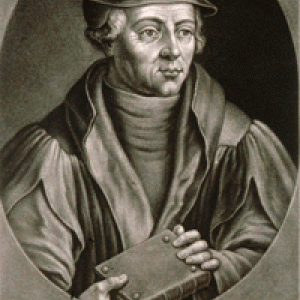
Beatus Rhenanus (Beat Bild)
Library
Bibliothèque Humaniste de Sélestat, le fonds légué par Beatus Rhenanus
View PDFBibliothèque Humaniste de Sélestat, le fonds légué par Beatus Rhenanus
Beatus Rhenanus’ library consists of both manuscripts and printed books. Since 1889, the collection has been located in the Halle aux Blès in Sèlestat, built in 1840s by Gustave Klotz. Beatus left his library to his hometown in his will, and the city of Sèlestat is still today in charge of conservation of the collection.
The library includes 432 volumes, which contain 1287 printed works, and 41 manuscripts bound together with printed texts. To these, we can add 264 manuscript letters and 33 volumes of manuscripts (94 works). Today the collection contains 1686 documents, conserved in Sélestat (there are also notebooks, letters, etc.). Every work presents a manuscript ex-libris of Beatus Rhenanus, which testifies to his affection for his library: «Sum beati rhenani Nec muto dominum» (I am property of Beatus Rhenanus and I do not change masters). After he obtained a title from Charles V in 1523, he placed his coat of arms on the books.
The collection includes many Parisian editions from the first half of the sixteenth century, many Aldine and Froben editions, but also works printed in Alsace, and books and manuscripts that Beatus inherited from his teacher Cuno. Cuno had previously worked for Aldo Manuzio in Venice, and died in Basel in 1513. Together, the books constitute the most important humanist library that has remained intact over the centuries.
Beatus’ annotations are numerous and very precise, a typical feature in the works of philologists. They include notes about earthquakes, a contract between Beatus and a peasant for a calf, and the costs for the funeral of Beatus’ father. The books themselves are written by a wide array of authors in a number of languages and cover a wide range of topics, which reflects the universalist outlook of the humanists. There are many works which Beatus obtained thanks to his network of contacts across Europe. Beyond Alsace he met great authors (Erasmus, Lèfevre d’Etaples, Budé), religious reformers (Melanchton, Bucer, Zwingli), printers (Estienne, Josse Bade, Matthis Schürer, Froben and Amerbach), but also princes (Charles V), important men (the Fuggers), high prelates (the bishop of Worms) and monks as well. In Sélestat there are several books which were employed as models for the publication of ancient texts across Europe.
Since January 2010, some of the books conserved at the Bibliothèque Humaniste have been made available online. The project is still in progress.
From: Bibliothèque Humaniste numérique,
- In the windowProvenance, key inrhenanus.